No-Code and Low-Code AI: Making AI Accessible for Everyone
Discover how no-code and low-code AI platforms make artificial intelligence accessible to everyone, without complex programming knowledge. Automate your processes today!
Last updated: 2026-04-18
AI is no longer reserved for experts with years of programming experience. Thanks to the rise of no-code AI tools and low-code AI platforms, artificial intelligence is now accessible to everyone. Whether you are an SMB owner, marketer, or data analyst, these platforms allow you to build and deploy powerful AI solutions without writing a single line of code, or with minimal programming effort.
The short answer: In this guide, we dive deeper into the world of AI automation without programming and show you how to use these tools to transform your business processes and gain a competitive edge.
Why AI has become accessible
Traditionally, developing AI models required specialized knowledge of machine learning, data science, and programming languages like Python. This created a barrier for many businesses and individuals who wanted to leverage the benefits of AI but lacked the resources or expertise to do so.
No-code AI tools and low-code AI platforms break this barrier by packaging AI functionalities into user-friendly interfaces. They empower the “citizen developer” to perform complex tasks:
- Visual development environments: Think of drag-and-drop functionality for building workflows and models.
- Pre-integrated AI models: Access to ready-to-use models for tasks such as text processing, image recognition, or predictive analytics.
- Simple integration: The ability to connect AI solutions with existing tools and systems (CRM, ERP, spreadsheets).
This makes AI for non-programmers a reality and opens the door to innovation for a much broader group of users.
No-code AI: AI without a single line of code
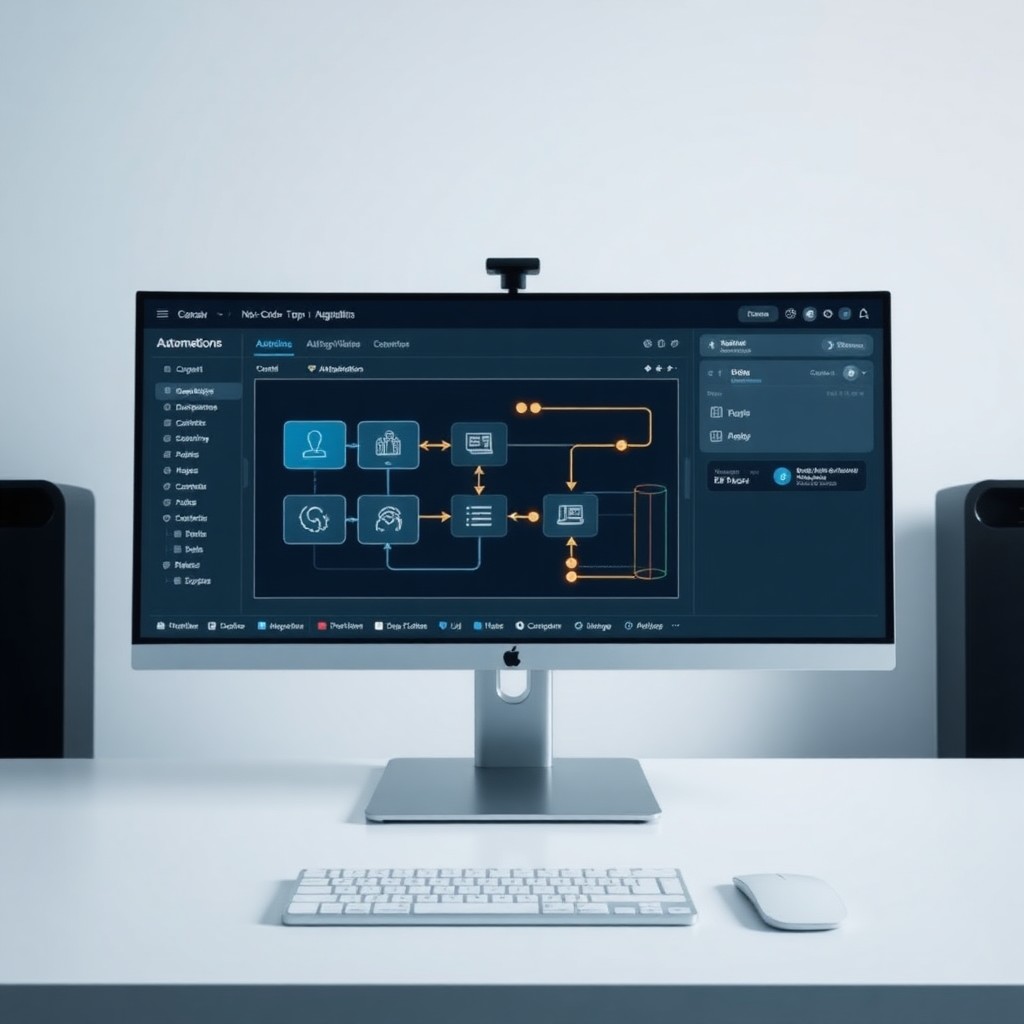
No-code AI tools are the ultimate solution for those with no programming knowledge at all. These platforms are designed to build AI applications through intuitive, visual interfaces. You build your application by clicking, dragging, and dropping, often using templates and presets.
Benefits of no-code AI
- Extremely fast development: You can implement a working AI solution in days, sometimes even hours.
- No programming knowledge required: Anyone can get started, from marketers to HR professionals.
- Reduced costs: Less reliance on expensive developers and faster time-to-market.
- Iteration and experimentation: Easily test hypotheses and implement adjustments.
Typical no-code AI applications
With no-code AI, you can build a wide range of AI-driven functions, such as:
- Chatbots and virtual assistants: Automate customer service and sales support on your website.
- Sentiment analysis: Analyze customer feedback (reviews, social media) to measure trends and customer satisfaction.
- Automated data extraction: Extract specific information from documents or emails.
- Simple image recognition: Categorize images or detect objects.
Popular no-code AI platforms
Some platforms that focus on the no-code approach for AI include:
- Akkio: A platform focused on predictive analytics, forecasting, and reporting, often by simply uploading data and choosing the insights you want to generate.
- Make (formerly Integromat): While known as an automation platform, Make also offers modules for integration with various AI services and the ability to build AI-driven workflows without deep coding.
- Clemens.ai: A platform focused on automating business processes with AI, often via a visual flow builder.
Low-code AI: Flexibility for advanced users
Low-code AI platforms offer a middle ground between pure no-code and traditional code development. They provide a visual development environment similar to no-code tools, but with the added ability to add code snippets where more customization or complexity is required. This makes them more powerful for complex projects or when you need to adapt specific AI models.
Benefits of low-code AI
- More flexibility and customization: You can serve specific use cases that are not possible with pure no-code.
- Faster development than traditional code: Still offers significant time savings compared to full-stack coding.
- Accessible to ‘citizen developers’ with some technical affinity: You don’t need deep programming knowledge, but basic insight is helpful.
- Scalability: Better suited for larger or more complex AI projects that need to grow further in the future.
Typical low-code AI applications
Low-code AI is used for more advanced applications or integrations:
- Personalized recommendation engines: Recommendations for products or content based on user behavior.
- Complex machine learning models: Building and training models for specific business problems, with the ability to fine-tune algorithms.
- Advanced business process automation: Think of automated approval workflows with AI decision support.
- Integration with legacy systems: Where specific API calls or data transformations are required.
Popular low-code AI platforms
Some leading low-code platforms that also offer AI functionalities:
- Microsoft Power Apps / Power Automate (with AI Builder): Part of the Microsoft Power Platform, allowing users to build business applications and automated workflows with minimal code, including AI functionality for forms, text recognition, and object detection.
- Google Cloud Vertex AI Workbench: While aimed more at data scientists, it offers low-code aspects via visual tools and templates for building, training, and deploying machine learning models.
- Appian: An enterprise low-code platform that focuses specifically on automating complex workflows and integrating AI/ML capabilities into business processes.
How to choose the right platform?
The choice between a no-code AI tool and a low-code AI platform depends on your specific needs, your technical expertise, and the complexity of your project.
- For the beginner with no coding experience: Start with no-code AI tools. These are perfect for experimenting quickly and creating immediate value.
- For the ‘citizen developer’ with technical affinity: Consider low-code AI platforms. These offer more growth potential and flexibility for complex projects.
- Determine your use case: What problem do you want to solve? A simple chatbot requires less functionality than a complex predictive model.
- Scalability: Think about the future. Will your application grow? Does it need to process large amounts of data?
- Integrations: What other systems do you already use? Ensure the platform integrates seamlessly with your existing tech stack.
- Costs: Compare pricing models. Some platforms work with a subscription model, others with usage-based costs.
The impact of accessible AI on SMBs
Accessible AI solutions for SMBs are a game-changer. Small and medium-sized businesses can now compete with larger players through smart automation and insights that were previously out of reach.
- Improved customer service: Chatbots that are available 24/7 and provide fast answers.
- Optimized business processes: Automate repetitive tasks, from sorting emails to invoice processing.
- Better decision-making: Predictive analytics that help with inventory management, marketing campaigns, or financial planning.
- Innovation: Test and launch new products and services faster with AI support.
The adoption of citizen developer AI allows companies to innovate faster, work more efficiently, and serve their customers better, without needing a large IT budget or a team of AI experts.
The role of AI in agent workflows and automation
No-code and low-code AI are crucial enablers for building smart agent workflows. An ‘agent’ in this context is an automated system that performs tasks, makes decisions, or processes information on your behalf.
With these platforms, you can, for example:
- Build an AI-driven
lead qualification agentthat analyzes incoming inquiries and forwards only the most promising ones to sales. - Build a
content curation agentthat filters relevant articles or news items based on set criteria and summarizes them automatically. - Build a
customer support agentthat answers frequently asked questions and escalates more complex issues to a human employee, including contextual information from previous interactions.
This is where the power of AI automation without programming truly comes into its own: it enables non-technical users to design and implement their own intelligent assistants and automated processes.
Related Articles
Best AI Subscriptions by Budget: Find Your Perfect Tool
Make vs n8n: Which Automation Tool Should You Choose?
Zapier Central Review: Autonomous AI Agents for Business Processes
Frequently Asked Questions
What is the difference between no-code and low-code AI?
No-code AI platforms require no programming knowledge and operate via visual drag-and-drop interfaces. Low-code AI platforms offer the option to add custom code for greater complexity and tailoring. Low-code is more flexible, while no-code is simpler and faster.
Who are no-code and low-code AI tools intended for?
These tools are ideal for SMBs, marketers, analysts, and entrepreneurs without a deep technical background who want to leverage AI for automation, analysis, or customer interaction without relying on developers.
What types of AI applications can I build with these platforms?
Depending on the platform and available modules, you can build chatbots, sentiment analysis tools, automated reporting systems, predictive analytics, image recognition, and personalized recommendation engines.
Are no-code/low-code AI solutions secure?
Security depends heavily on the chosen platform and implementation. Reliable providers maintain strict security protocols and data protection standards (such as GDPR). It is essential to verify a platform’s security measures before processing sensitive data.
How useful was this article?
Can you briefly tell us what could be better?
Get AI updates?
One practical tip per week. No hype, only useful comparisons and workflow insights.